Chinese Medicine is Cure of the Coronavirus - Western Medicine or Chinese Medicine? WHICHEVER can SAVE the lives and cure illness is the BEST medicine!
Lung Cleansing and Detoxifying Decoction is CURE of Pneumonia by Coronavius -Covild-19
The Vice President of Beijing University of Traditional Chinese Medicine, Prof. Wei Wang, said on the Press Conference of the Joint Prevention and Control Mechanism of State Council on April 17. 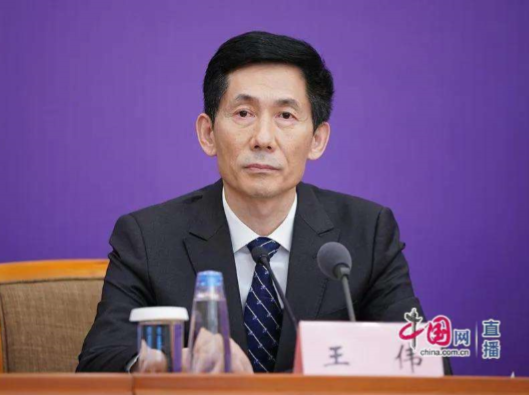 Wang said that clinical observation and research show that Lung Cleansing and Detoxifying Decoction is good applicable to mild, moderate, and severe pneumonia patients caused by Coronavirus, and it is fast, safe, high proficient in treating the disease, therefore he believes that Lung Cleansing and Detoxifying Decoction is the CURE of the pneumonia. He welcomes comparation with other treatments by domestic and oversea medics and researchers.
Lung Cleansing and Detoxifying Decoction is broadly used in treating patients in 28 Provinces in China and has become the most important treatment in this epidemic. By April 12, it has been used in treating 1262 patients. 1253 or 99.8% patients have been cured! Among them 57 are severe patients, the curing effect is very good! None of the 1262 patients turned into severe case from mild case, or from moderate case to critical case. The results are wonderful because it prevented patients turned into critical case. This is very important point!
Wang also released that profound researches are conducted. 300+ chemical components and 200+blood entering constituents are investigated, and 790+targets are found. The researches show that this medicine controls and treats the pneumonia by Coronavirus through multiple components and multiple processes. In particular, it CAN effectively contain the virus poison and avoid or mitigate Inflammatory storm。
Chinese Government Authority approved 3 drugs to treat Coronavirus virus (Covid-19)
The Chinese government has acknowledged the important role TCM has played in treating COVID-19 patients and has added treatment of the virus to the specifications of three traditional medicines, a top TCM expert said on Wednesday.
Zhang Boli, an academician of the Chinese Academy of Engineering and president of Tianjin University of Traditional Chinese Medicine,
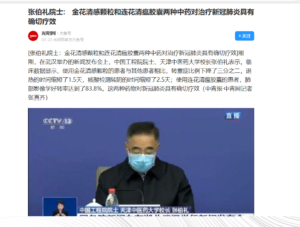 said the three Chinese patent medicines-Jinhua Qinggan Granule, Lianhua Qingwen Capsule and Xuebijing Injection-have proved clinically effective in treating COVID-19.
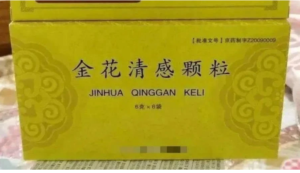
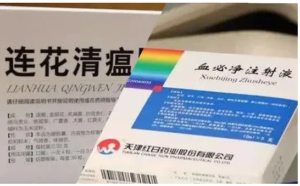
Adding the treatment of COVID-19 to the specifications of the three medicines means they can be widely used across the country to treat patients, Zhang said. (Feel free to contact us for these effective Traditional Chinese Medicine, we will do our best. Email: ok1ok2ok@hotmail.com phone: +86-13230481935)
One of the three medicines, Lianhua Qingwen capsule, has won approval to enter the Thai market, and French researchers plan to conduct clinical research into using it to treat patients, he said.
"After more than two months of clinical research, we have chosen the three medicines out of hundreds of TCM medicines that are effective in treating cold and flu," he said.
"By introducing the medicines abroad, we hope that they can save more people as the pandemic continues to worsen globally," he said.
Li Yu, director of the Department of Science and Technology at the National Administration of Traditional Chinese Medicine, said Jinhua Qinggan Granule, developed during the 2009 H1N1 influenza pandemic, is effective in treating mild and moderate COVID-19 patients. Lianhua Qingwen capsule is also effective in treating mild and moderate patients, especially in improving symptoms like fever, cough and fatigue.
Xuebijing Injection is often used in treating severe and critically ill patients. It can increase the recovery rate and reduce the deterioration rate, Li said at a news conference on Tuesday.
Two TCM prescriptions-Lung Cleansing and Detoxifying Decoction, and Huashibaidu Formula-have been approved by the National Medical Products Administration for clinical trials, he said.
Lung Cleansing and Detoxifying Decoction is suitable for patients with light, moderate or severe symptoms, Li said.
Wang Rongbing, director physician with Beijing Ditan Hospital, said the prescription has been used at 28 provincial regions in treating COVID-19 patients in all stages with various symptoms, yielding good outcomes.
None of the 1,265 confirmed cases in 66 designated hospitals in 10 provincial regions that have used the prescription has shown worsened symptoms. Ninety-eight percent of patients had been discharged by March 23, Wang said at a news conference in March.
A team of Chinese experts in traditional Chinese medicine shares their experience in novel coronavirus treatment with US counterparts
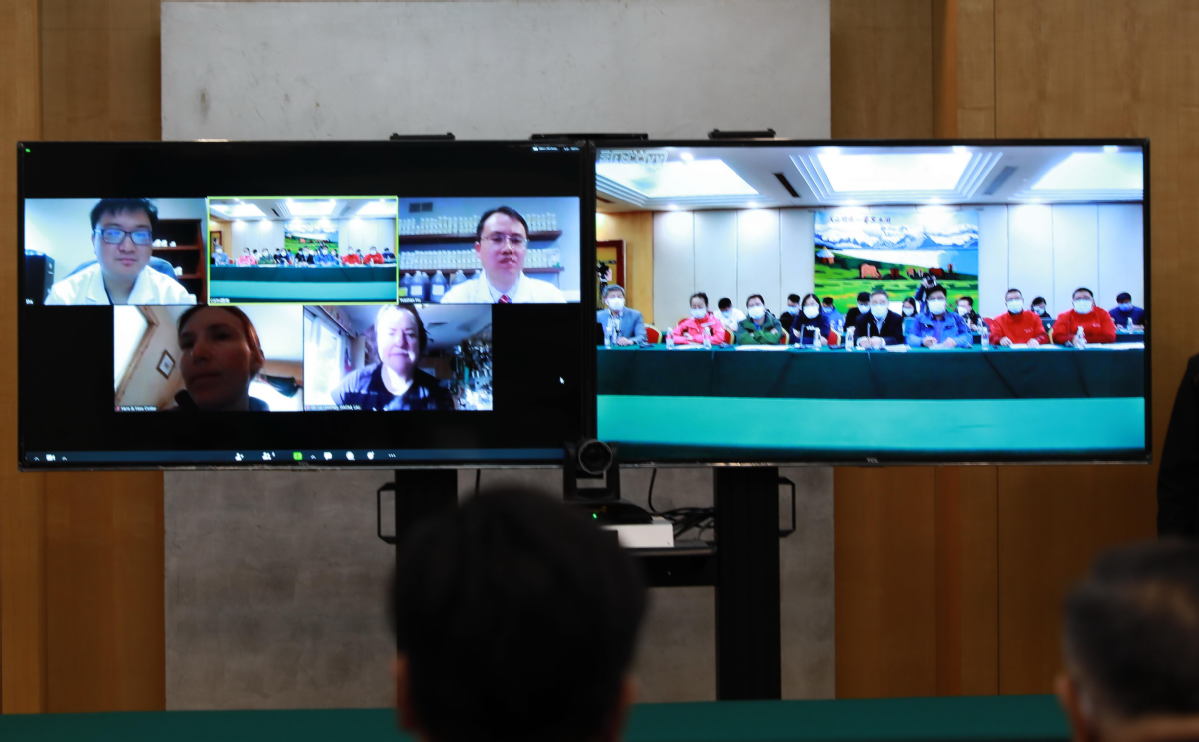
How to treat COVID-19 with TCM? A team of Chinese experts in traditional Chinese medicine shares their experience in novel coronavirus treatment with US counterparts.
Traditional Chinese medicine has been used to combat more than 500 outbreaks of pestilence in a long history since the first pandemic in 243 BC recorded in Shi Ji (Historical Records) to 1949.
Plentiful experience has accumulated in the TCM practice of pestilence containment, and a full theoretical system of anti-pestilence has been formed in TCM.
TCM's angle of COVID-19
COVID-19 falls under the category of "pestilence" and it can be called "lung pestilence" based on its cause, pathogenic sites and characteristics. It is "dampness-toxin pestilence", according to the characteristics of cases. The pathological nature mainly shows dampness, heat, toxin, deficiency, and stasis.
COVID-19 can be divided into 5 phases as mild, moderate, severe, critical stage, and a recovery stage, by the characteristics of the symptoms and syndromes.
Comparing COVID-19 with SARS: COVID-19 pertains to dampness-toxin pestilence and SARS is a warm pestilence.
From the view of epidemiologic features, COVID-19 has stronger infectivity and less virulence than SARS. Judging from the number of infected cases and mortality, there were over 80,000 confirmed cases of COVID-19 in China and the mortality rate was about 3 percent, but there were only over 7,000 confirmed cases of SARS, and the mortality rate was 11 percent. From clinical features, COVID-19 shows mild fever and attacks multiple organs besides the lungs, especially causing severe damage to the immune system; SARS caused milder damage to the immune system.
Some patients with COVID-19 after discharge have tested positive again in nucleic acid testing, and some postmortem results showed the existence of damage accompanied by mucous secreta in the deep airways and pulmonary alveoli.
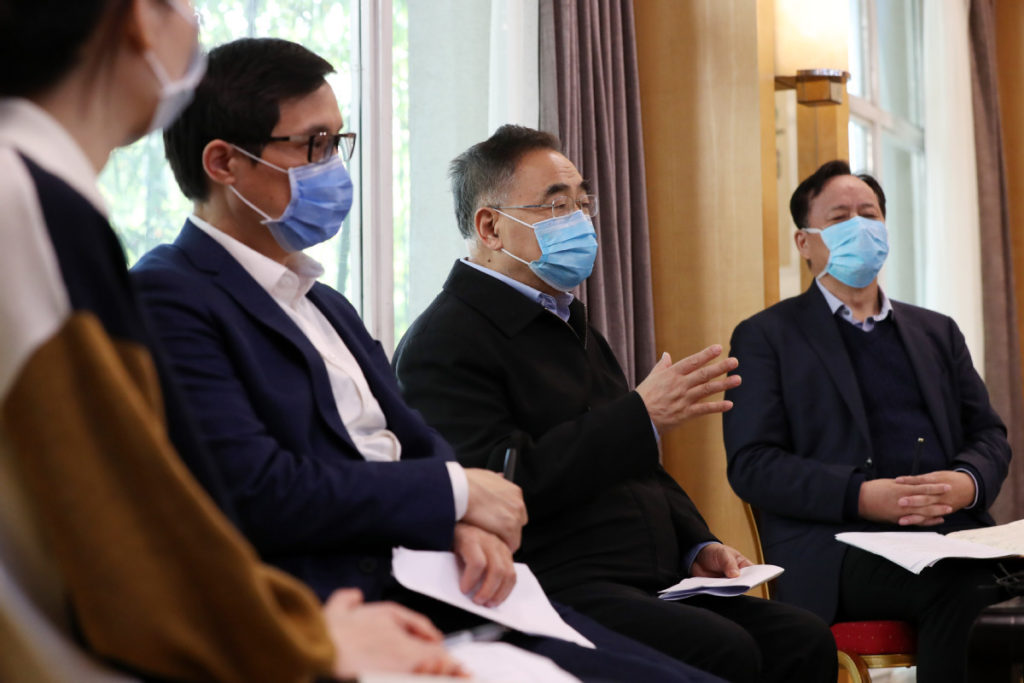
Zhang Boli (center) from the Chinese Academy of Engineering and president of Tianjin University of Traditional Chinese Medicine; Tong Xiaolin (right), from the Chinese Academy of Sciences and head researcher of the China Academy of Chinese Medical Sciences; and Huang Luqi (left), from the Chinese Academy of Engineering and president of the China Academy of Chinese Medical Sciences. Three experts in traditional Chinese medicine area attend a news conference to introduce prescriptions of TCM treatment to patients with novel coronavirus pneumonia, in Wuhan, Hubei province, on March 14, 2020
Integration of TCM and Western medicine
About 4,900 TCM medics, accounting for 13 percent of total medics, assist the fight against COVID-19 in Wuhan. There were 74,187 patients, or 91.5 percent of the total across the country, received TCM treatment and 61,449 patients, or 90.6 percent of the total in Hubei province, received TCM treatment.
TCM has played a full role in treating COVID-19 patients in different phases, improving situations of mild and moderate patients and significantly reducing the proportion of mild and moderate patients turning into critical cases.
TCM injection should be applied as soon as possible in critical cases. For example, Shengmai Zhusheye (pulse-generating injection) and Shenmai Zhusheye (ginseng and ophiopogon tuber injection) stabilize patients' blood oxygen level. Xuebijing Zhusheye (blood-cleaning injection) affects the control of inflammatory reaction, and Reduning Zhusheye (heat-toxin-eliminating injection) and Tanreqing Zhusheye (sputum-heat clearing injection) have a synergetic effect with antibiotics.
TCM promoted recovery and reduced sequelae for patients at the recovery stage. For example, it improved symptoms, enhanced inflammatory absorption in the lungs, reduced adhesion, and promoted thorough repair of damaged organs and tissues.
Seven editions of Diagnosis and Treatment Protocol for COVID-19 have been successfully released in China, and TCM treatment was recommended for patients at different phases.
Zhang Boli took charge of an emergency project under the Ministry of Science and Technology in the clinical comparison of integrated use of TCM and Western medicine and single use of Western medicine.
At Hubei Provincial Integration of Chinese and Western Medicine Hospital, 34 COVID-19 patients were treated with an integration of Chinese and Western medicine, and were superior to patients only using Western drugs.
Improvements in the integrated treatment group included in the clinical symptom reduction time, temperature recovery time, average hospital stay, CT imaging, and the proportion of patients with moderate symptoms turning into critical cases.
Chinese herbs/patent medicines were used for fighting against the outbreak in Wuhan and medics have summed up several medicines with better treatment effects.
It is concluded that there are "Three Patent Medicines and Three TCM Formulae". The Three Patent Medicines indicate Lianhua Qingwen Jiaonang (forsythiae and honeysuckle flower pestilence-clearing capsules), Jinhua Qinggan Keli(honeysuckle flower cold-relieving cranules), and Xuebijing Zhusheye (blood-purifying injection). The Three TCM Formulae refer to Qingfei Paidu Tang (lung-cleansing and toxin-removing decoction), Huashi Baidu Fang (dampness-resolving & toxin-removing formula), and Xuanfei Baidu Fang (lung-diffusing and toxin-removing formula). The results of research on those medicines and formulae mentioned above showed reliable treatment effects and clearer mechanism of action.
Passing on the experience
In January, crowds of people were seen in a Wuhan hospital, which caused a large number of cross infections.
In late January and early February, people in four groups of fever, close contacts, suspected patients and under medical observation were isolated intensively and received Chinese medicine decoctions in Wuhan. Does TCM treatment work? Testing and statistics showed that the positive rate of the people in the four groups was up to 80 percent in early February, but after taking TCM for 10 days, the positive rate decreased to 30 percent, and in late February, less than 10 percent were tested positive. TCM functioned in preventing and blocking the progression of COVID-19.
The second experience was to divide people in groups with their symptoms for scientific treatment. Patients with mild symptoms were separated from the ones with severe symptoms. The patients with mild symptoms were treated at the makeshift hospitals (Fangcang Yiyuan in Chinese pinyin) and those with severe symptoms were treated at designated hospitals.
At Jiangxia Makeshift Hospital, which Zhang Boli took charge of, 564 patients with mild and moderate symptoms received TCM treatment. Among them, not one patient turned into a severe case, no patient after discharge tested positive again, and no medical workers were infected.
The third was the integration use of TCM and Western medicines for severe patients. Professor Liu Qingquan from Beijing TCM Hospital led the treatment with both TCM and Western drugs for some medical staff who were infected at Wuhan Center Hospital. Chinese and Western medicine complemented each other with advantages and jointly saved lives, and many critically ill patients turned into mild cases.
Fourth, patients at the recovery stage also were treated with the method of integration of Chinese and Western medicine. The criteria for recovery with the integration of Chinese and Western medicine will be released.
For about 3,000 medical workers infected with COVID-19, the integration use of TCM and Western drugs will be applied to them too.
Suggestions on future actions from WFCMS
1. In the global fight against COVID-19, all methods that can effectively contain COVID-19 should be widely used. We suggested the WHO recommend TCM and Chinese patent medicines that have been proven to be effective on COVID-19 to fight against the pandemic.
2. In this anti-pandemic work, clinical use and observation of more than 70,000 confirmed cases showed that TCM can effectively alleviate symptoms, reduce the progression of light and moderate to severe, improve the cure rate, reduce the mortality rate, and promote recovery during the rehabilitation period. The total effective rate reached over 90 percent. The combined use of TCM and Western medicine has played an active role. The integrated use can quickly help mild patients improve clinical symptoms and help shorten the length of a hospital stay in epidemic containment. It is a practical and effective medical method. We suggested the WHO recommend TCM to be used in countries around the world.
3. According to the "WHO Traditional Medicine Strategy" and the collaboration plan between the WHO and WFCMS, we are going to improve on the collaboration in developing Chinese medicine standards and evidence-based medicine research, and further promote TCM to take a part in global health governance, so that can serve human health much better.
Break through the darkness and we will see the stars again.